AI Automation for Businesses in Qatar: A Practical Guide
- Author
- Category
- Getting started
- Date
- Read
- 10 min read


AI automation for businesses in Qatar means connecting your everyday tools — WhatsApp, email, your CRM, spreadsheets, payment systems — to AI software that handles repetitive work on its own. For most teams in Doha, that starts with customer support, sales follow-ups, and back-office finance. The goal is not to replace people, but to give your team the capacity to do the work that actually needs them.
What is AI automation, in plain terms?
AI automation is software that completes a task, start to finish, with little or no human involvement. A customer writes a WhatsApp message at 11 p.m.; the system understands the question, pulls the right answer, and replies — or quietly routes the conversation to the one person on your team who can truly help. An invoice arrives in Arabic; the system reads it, pulls out the numbers, and records them in your accounts, ready for someone to review.
It is worth separating three ideas that get mixed up together. AI understands — language, context, intent. Automation follows a fixed path — if X happens, do Y. AI automation combines the two, so software can handle tasks that used to need a person's judgment, not just their typing. Chatbots that follow a script are automation only. AI agents go further: they read, decide, act, and hand things over when they reach their limit.
Why this matters for businesses in Qatar right now
Three forces are pushing Qatari companies toward AI automation at the same time, and understanding them helps you judge whether the timing is right for your own business.
The cost of hiring keeps climbing
Qatar's labour market has tightened in recent years, and the cost of hiring and retaining skilled staff has risen with it. For a business doing the same tasks repeatedly — answering the same ten questions, chasing the same invoices, logging the same data — that rising cost makes a strong case for software that handles the routine and lets people focus on relationships and judgment.
Customers now expect fast answers
Whether they shop in Villaggio or place an order online, customers in Qatar compare service experiences across borders. They expect an answer in minutes, at any hour, in English or Arabic. Meeting that expectation with people alone means night shifts and weekend coverage. Meeting it with a well-built AI system means the same quality of response at 3 a.m. as at 10 a.m.
National direction and infrastructure
Qatar National Vision 2030 places knowledge and digital capability at the centre of the economy, and the country's investment in AI — including the Qatar National AI Strategy launched by the Ministry of Communications and Information Technology — signals long-term government support for adoption. For a business owner, that direction is useful context: the skills, regulations, and service providers supporting AI are being built here, not imported temporarily.
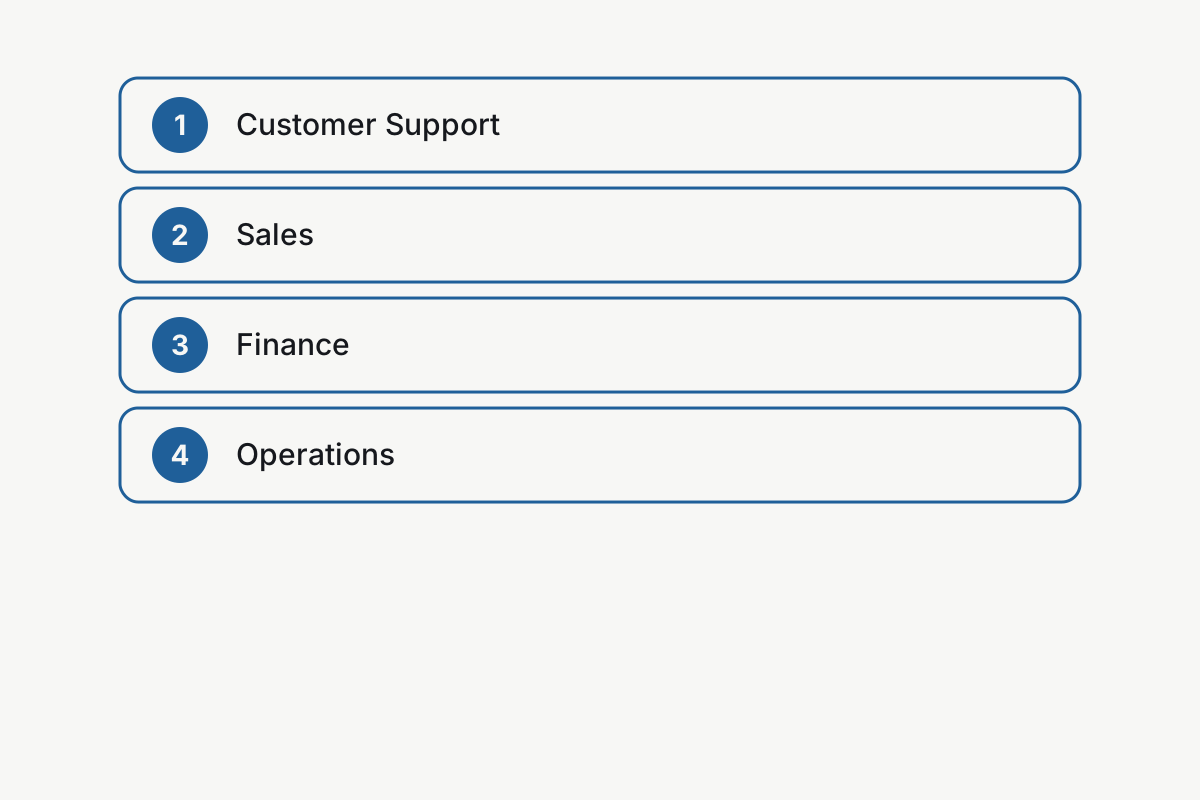
Where AI automation earns its keep: four core areas
Almost every AI automation project in Qatar fits into one of four areas. Knowing which one yours falls into shapes the tools you evaluate, the budget you need, and the first project you pick.
1. Customer support and service
This is where most teams start, because the problem is visible every day: messages unanswered outside working hours, the same questions asked and answered dozens of times a week, conversations in two languages that double the workload.
An AI support system reads each WhatsApp or email message, answers the routine ones, and escalates the genuinely complex ones with a summary of what the customer has already said. For a service business in Doha, that usually means the customer gets an answer in seconds instead of hours, and your team spends their shift on the conversations that build loyalty.
If this is your starting point, the full picture is in our guide to ai customer support automation qatar.
2. Sales and lead follow-up
A lead comes in from Instagram, a website form, or a WhatsApp message. In many businesses, that lead waits — sometimes a day, sometimes longer — before anyone responds. Research on lead response times consistently shows that response speed is one of the strongest predictors of conversion.
AI sales automation changes that sequence. The system acknowledges the lead instantly, asks the qualifying questions, books a call or meeting if appropriate, and follows up automatically if the lead goes quiet. Your sales team steps in at the point where a human conversation actually moves the deal.
We cover the mechanics and the typical setup in our guide to ai sales automation qatar.
3. Finance and back-office work
Invoices, payment reminders, expense categorisation, reconciliation — the finance function in a small or mid-sized business is full of tasks that follow rules and repeat weekly. AI reads documents (including Arabic-language ones), extracts the relevant data, matches it against existing records, and flags only the exceptions for human review.
The result is not that your accountant disappears. It is that they stop spending Friday afternoons copying numbers between systems, and start spending that time on the analysis that actually informs your decisions.
Our guide to finance automation ai qatar walks through the typical setup and the tools involved.
4. Operations and internal workflows
This is the broadest category and the least visible from outside. It covers everything from automatic reporting and task assignment to document generation and internal approvals. When a sales deal closes, does the handover to the delivery team happen automatically, or does someone write an email and hope it is read? When a new client signs, does the onboarding checklist trigger itself, or does a project manager build it from scratch each time?
Operations automation connects these steps so they run on their own. For a deeper look at what this looks like in practice, see our guide to operations automation ai qatar.
Common scenarios in the Qatari market
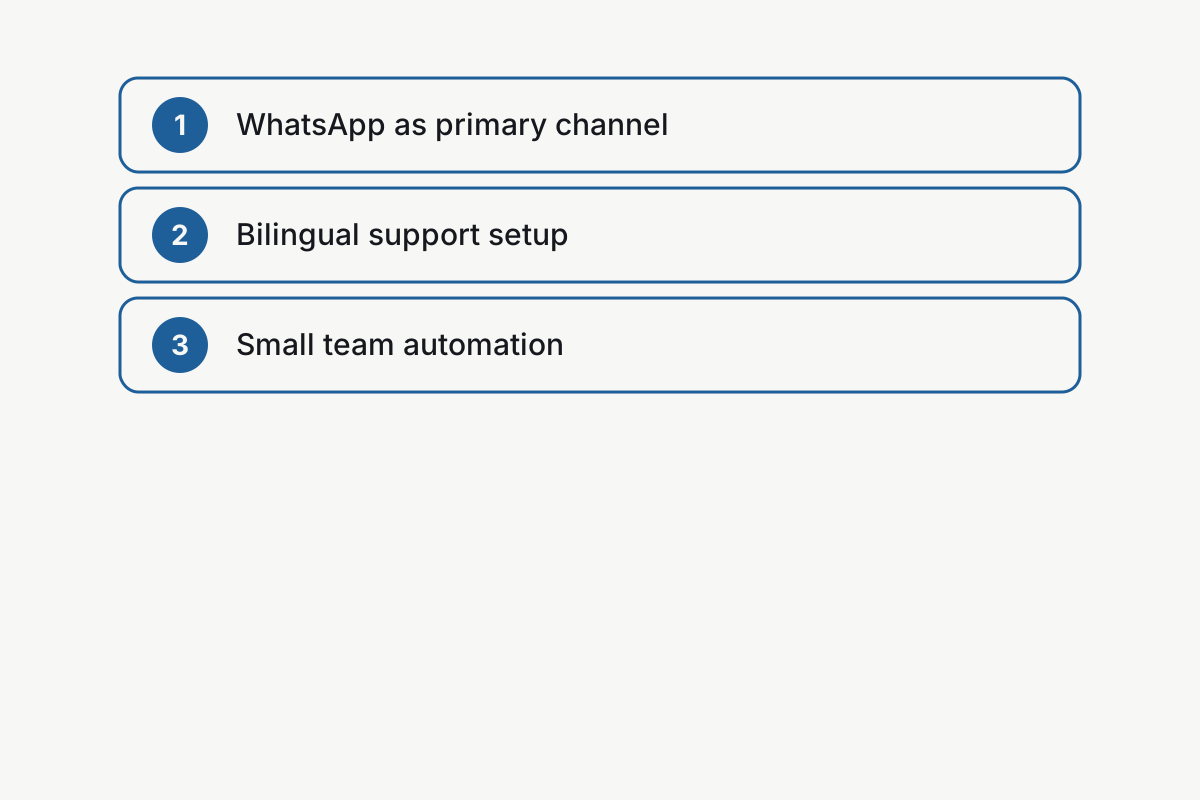
The four areas above are categories. What follows are the kinds of projects we see most often from businesses based in Doha and the wider Qatar market. If your situation matches one of these, the starting point is usually clearer.
WhatsApp is the front door
In Qatar, WhatsApp is not a secondary channel — it is often the primary one. Customers message a business the way they would message a friend. That means any AI automation project that ignores WhatsApp is missing the highest-volume conversation channel from day one. The good news is that WhatsApp Business API integration is one of the most straightforward places to start, and the return shows up quickly in response times and after-hours coverage.
Bilingual support is not optional
Your customers speak English and Arabic, often switching between them in the same conversation. An AI system that handles only one language is solving half the problem. Modern language models handle both well, but the setup matters: your knowledge base, your tone, and your escalation rules need to work in both languages from the start.
Small teams, high service expectations
Many Qatari businesses run with a team of five to twenty people, serving clients who expect a level of responsiveness that would normally require a much larger operation. AI automation is particularly powerful in this situation because it extends a small team's capacity without adding headcount — a response in two minutes, a follow-up the next morning, a report generated automatically at month-end.
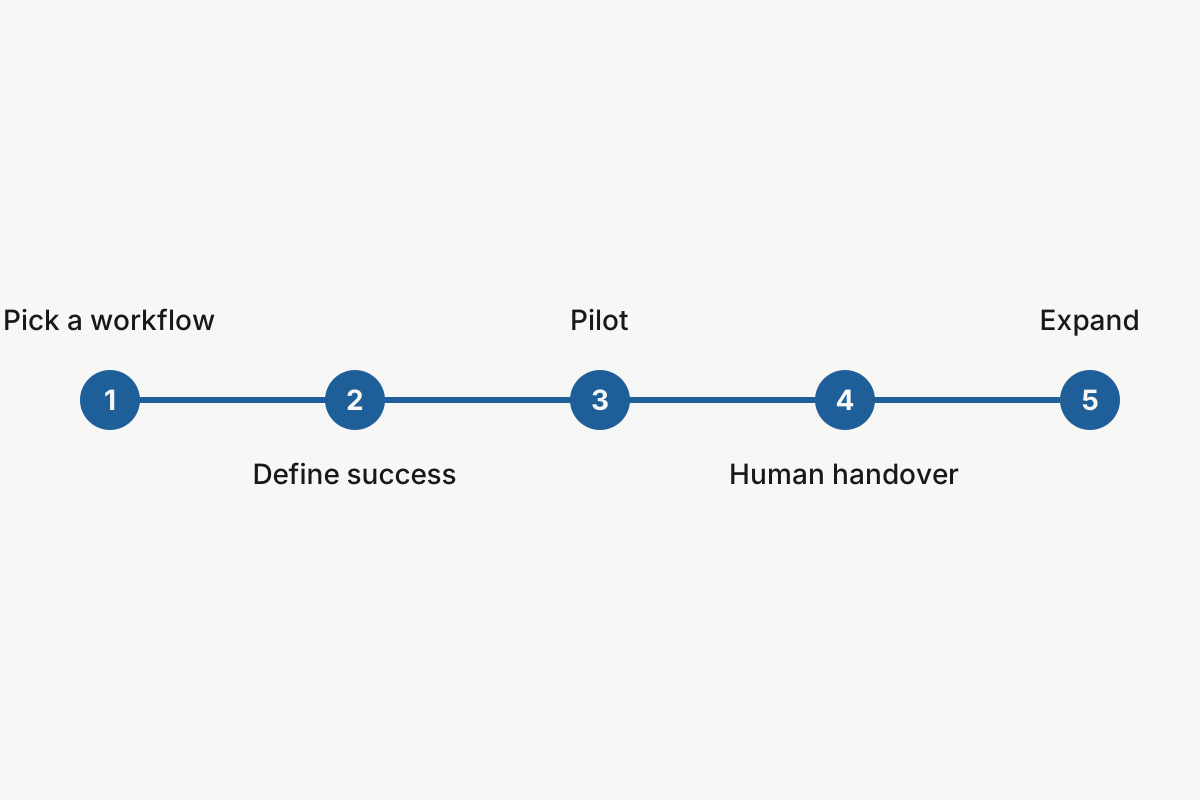
How to get started: a practical sequence
If you have decided to explore AI automation, the question is usually not whether to start, but where. Here is a sequence that works for most businesses in Qatar, whether they have five people or fifty.
Step 1: Pick one workflow, not a platform
The most common early mistake is buying a platform and then looking for something to automate. Start the other way round. Find the one task your team does every day that follows clear rules, takes meaningful time, and causes frustration when done poorly. For many businesses, that is answering the same customer questions repeatedly. For others, it is chasing unpaid invoices or sending the same follow-up messages to cold leads.
Step 2: Define what success looks like before you build
Write down the number you want to change. Average response time. Hours spent per week on a task. Percentage of leads contacted within one hour. Having a baseline makes the pilot measurable and makes the decision to scale an evidence-based one, not a feeling.
Step 3: Start with a pilot, not a full rollout
A pilot is a single workflow, live, with a defined set of inputs, running for a defined period. Two to four weeks is usually enough to see whether the system handles the volume and quality you expected. During the pilot, expect to adjust the rules, improve the responses, and clarify the handover points where a human takes over.
Step 4: Get the human handover right
AI automation does not remove people from the loop — it changes where they enter it. The handover is the moment a conversation or task passes from the system to a team member. Done well, the handover includes a summary of what happened, what the customer or colleague needs, and what has already been tried. Done poorly, it feels like starting over. Design the handover deliberately; it is the difference between a system your team trusts and one they resent.
Step 5: Expand one workflow at a time
Once the first workflow is stable and the numbers support it, add the next one. Resist the temptation to automate five things at once. Each new workflow needs its own rules, its own testing, and its own handover logic. Sequential expansion is slower, but it produces a system that holds together rather than one that needs constant fixing.
What it costs and what to budget for
AI automation costs in Qatar vary significantly depending on scope. A single WhatsApp support workflow is a different investment from a connected system covering sales, support, and finance.
What holds true across projects: the pilot is the cheapest version of the outcome. If you cannot justify the pilot cost, the full build will not justify itself either. Budget for the software, the setup, and the first round of adjustments — the last of these is often underestimated.
Common mistakes to avoid
Most failed AI automation projects fail for one of four reasons, and all four are avoidable if you know they are coming.
Automating a broken process. If the underlying workflow is unclear or inconsistent, the automation will reproduce the inconsistency faster. Fix the process first, then automate it.
Skipping the pilot. Going straight to a full rollout without a small test means you discover the problems at scale, when they are expensive and visible to customers.
Ignoring Arabic. Setting up a system in English and planning to add Arabic later usually means Arabic never gets the same quality of attention. Build both in from the start.
Expecting zero maintenance. AI systems need reviewing. Responses drift, business rules change, new products or services need to be added to the knowledge base. Budget a small amount of ongoing time for this, or assign it to a specific person.
How Baynor helps
Baynor is an AI automation company based in Qatar. We design and build the systems described in this guide — WhatsApp support, sales follow-up, finance workflows, and operations automation — for businesses in Doha and beyond. Because we work in the local market, our setups are bilingual by default, WhatsApp-first, and built around the way Qatari businesses actually operate, not around a template imported from elsewhere.
If you are exploring whatsapp business automation qatar or want to understand what an AI setup would look like for your specific workflow, the conversation starts with your current process, not with a product demo. Learn more about our team, or reach out directly to talk through whether a pilot makes sense for your situation.
FAQ
How long does it take to set up AI automation in a Qatari business?
A single-workflow pilot — such as WhatsApp customer support or automated lead follow-up — typically goes live within two to four weeks. A broader setup covering several departments takes longer, but the best approach is to start with one workflow, prove it works, and expand from there.
Does AI automation work for small businesses in Qatar, or only large companies?
It works particularly well for small businesses, because the gain in capacity is most visible when the team is small. A five-person business that automates its WhatsApp responses and invoice reminders gets the operational reach of a much larger team without the payroll. The key is starting with one clear workflow, not trying to automate everything at once.
Will AI automation replace my staff?
In practice, the teams that adopt AI automation well do not reduce headcount — they redeploy it. The system handles the repetitive, rules-based tasks, and the people spend their time on the work that requires judgment, empathy, and local knowledge. The design goal is to remove the work no one wants to do, not to remove the person doing it.
Can the AI handle Arabic and English together?
Yes. Modern language models handle both Arabic and English, and customers frequently switch between them in the same conversation. The important part of the setup is making sure your knowledge base, your tone of voice, and your escalation rules are built in both languages from the start, not added as an afterthought.
What is the first thing I should automate?
For most businesses in Qatar, the highest-impact starting point is either customer support (WhatsApp responses outside working hours, repeated questions) or sales follow-up (acknowledging and qualifying new leads immediately). Pick whichever one is causing the most visible friction right now — that is where the return shows up fastest.
Do I need technical staff in-house to run AI automation?
No. Most AI automation systems are managed by a setup partner and require minimal ongoing technical input from the business itself. You need one person who understands the business process being automated and can review how the system is performing. That is usually an operations manager or a team lead, not a developer.
If you would like to talk through a specific workflow, contact Baynor or visit our team page to understand who you would be working with.