The AI Knowledge Base: Automate Customer Support on WhatsApp
- Author
- Category
- Customer support
- Date
- Read
- 10 min read

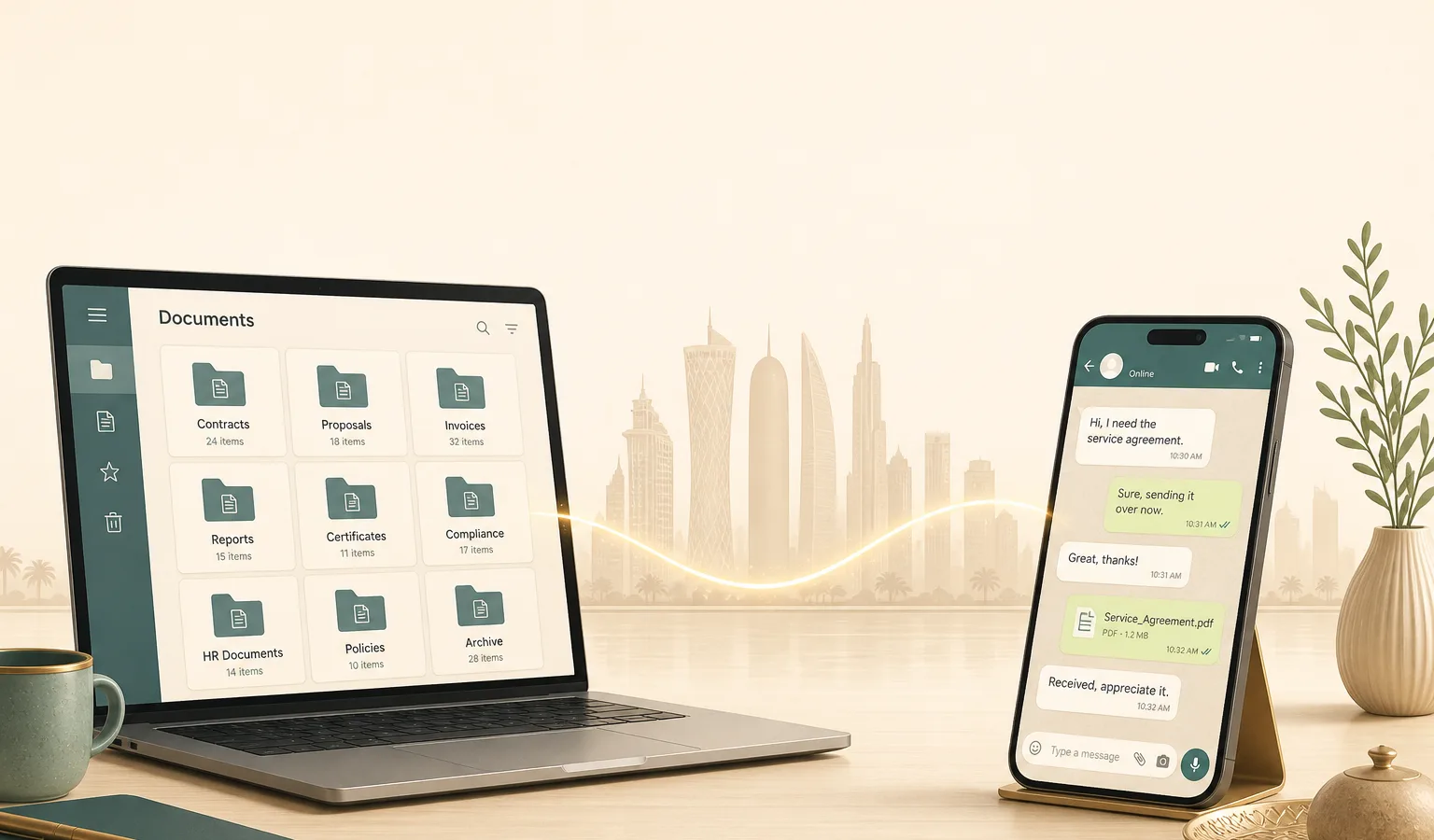
An ai knowledge base customer support system is a structured library of verified answers, product details, policies, and procedures that an AI system searches in real time to reply to customer questions. When connected to WhatsApp, it lets a business in Qatar answer common support enquiries instantly, in Arabic and English, around the clock, without adding headcount. The AI reads each incoming message, matches it to the most relevant entry in the knowledge base, and sends a clear, accurate reply in under a second.
What is an AI knowledge base for customer support?
Think of it as your company's single source of truth, made readable by a machine. A traditional knowledge base is a collection of help articles, FAQ pages, and internal documents that a human agent searches manually when a customer asks a question. An AI knowledge base takes that same content and organises it so a language model can retrieve the right answer automatically, the moment a question arrives.
The difference matters most on WhatsApp. In Qatar, WhatsApp is the default channel for customer conversations. People message a business the way they message a friend: short, informal, expecting a fast reply. A human agent can manage that during office hours, but the moment volume rises or the clock passes six in the evening, response times stretch and customers go quiet.
An AI knowledge base removes that bottleneck. It sits behind your WhatsApp Business number, reads every incoming message, and pulls the correct answer from your own content. It does not guess. It does not improvise. It answers from what you have written and approved.
Why this matters for businesses in Qatar
Qatar's customer expectations are shaped by a few realities that make WhatsApp support both essential and difficult to scale.
First, WhatsApp is where your customers already are. For B2B and B2C companies across Doha and beyond, WhatsApp is the first channel a customer reaches for when they have a question about an order, a service, a policy, or a price. It is faster than email, more personal than a web form, and more convenient than a phone call.
Second, Qatar's workforce is multilingual. A single support inbox may receive questions in Arabic, English, Hindi, Tagalog, or Urdu within the same hour. Hiring agents who cover every language combination is expensive and often impractical. An AI knowledge base can be loaded with content in multiple languages and reply in the language the customer used.
Third, the working day does not match the question day. A customer browsing your services at ten in the evening wants an answer at ten in the evening, not at nine the next morning. An AI knowledge base answers the repetitive ones instantly, so your human team spends their hours on the enquiries that genuinely need judgment.
How an AI knowledge base works on WhatsApp
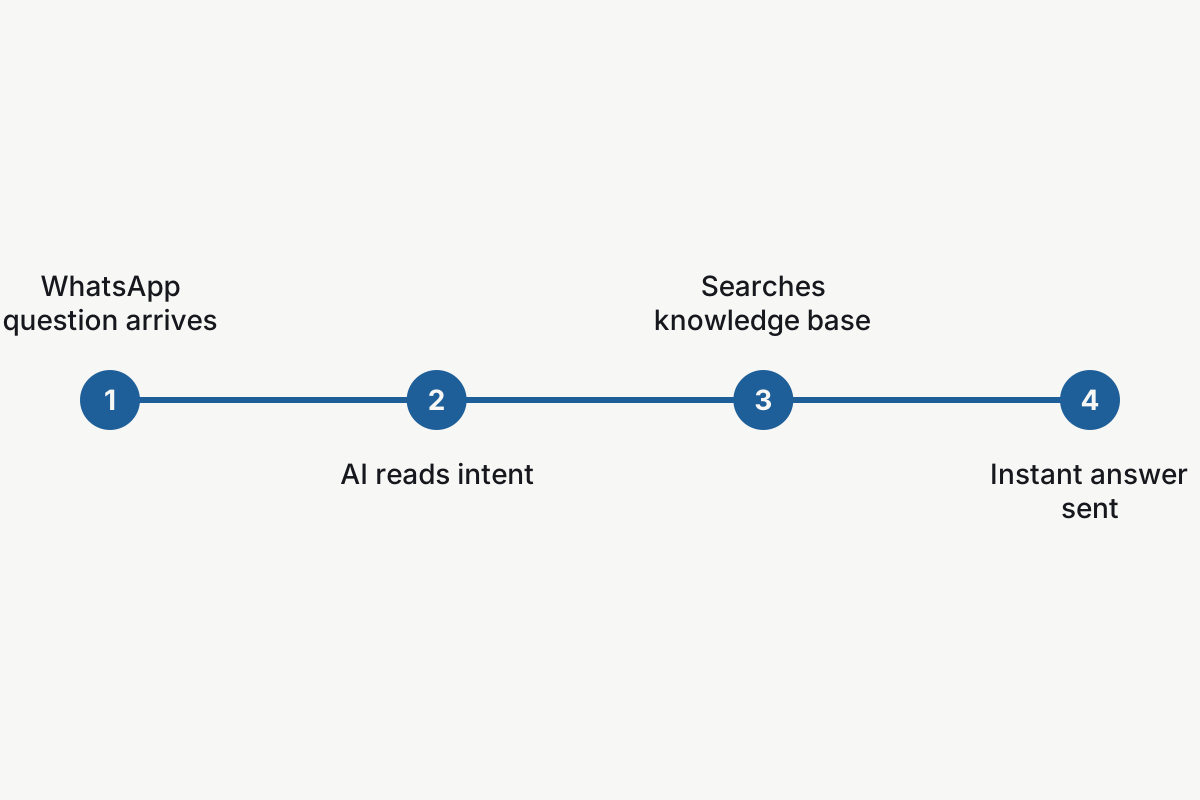
The mechanics are straightforward once you see the flow. Here is what happens from the moment a customer sends a message to the moment they receive an answer.
Step one: the customer sends a WhatsApp message to your business number. It might be "What are your delivery times?" or "How do I cancel my subscription?" or a question in Arabic about a specific product.
Step two: the AI reads the message and identifies the intent. It is not doing a keyword search. It understands what the person is actually asking, even if the phrasing is informal, abbreviated, or mixed between two languages.
Step three: the AI searches the knowledge base. It scans the structured entries you have loaded, finds the one most relevant to the question, and extracts the answer. If the knowledge base contains your delivery policy, pricing tiers, return rules, service descriptions, and troubleshooting steps, the AI picks the right section.
Step four: the AI composes a reply in natural, conversational language and sends it back on WhatsApp. The whole cycle takes under a second. The customer sees a helpful answer, not a queue number.
Step five: if the question falls outside the knowledge base, or if the AI's confidence in its answer is low, the conversation is handed to a human agent. The customer is never left without a response, and your team only sees the questions that truly need a person.
What goes into the knowledge base
The quality of every answer depends entirely on the quality of the content you load. A strong AI knowledge base for WhatsApp support typically includes the following.
Frequently asked questions
The questions your team already answers ten times a day. Delivery times, payment methods, service coverage areas, office hours, parking details, booking procedures. Write each one as a clear question-and-answer pair. The more natural and specific the phrasing, the better the AI matches real customer messages.
Product and service descriptions
Not your marketing copy. The factual, structured details: what each service includes, what it does not include, eligibility criteria, pricing structure if you share it publicly, and the steps a customer follows to get started.
Policies and procedures
Return policies, cancellation terms, warranty conditions, escalation paths. These are the answers customers most need and least enjoy waiting for. Put them in the knowledge base in plain language, not legal phrasing, and the AI can relay them clearly.
Troubleshooting steps
If your product or service has common issues, write the fix as a numbered sequence. The AI can walk a customer through it step by step on WhatsApp, the same way a patient support agent would, but without the hold time.
Internal escalation notes
Not for the customer, but for the handoff. When the AI passes a conversation to a human, it can attach context: what the customer asked, what the AI already answered, and where the conversation left off. Your agent picks up without making the customer repeat themselves.
The business case: what changes when you automate
The practical gains fall into four areas.
Response time drops from hours to seconds for routine questions. A customer who messages at midnight gets the same answer quality as one who messages at noon.
Your human team focuses on high-value work. Instead of answering "What are your opening hours?" forty times a day, agents handle complex complaints, negotiation, and relationship-building conversations.
Consistency improves. Every customer gets the same accurate answer, regardless of which agent would have handled the message. The knowledge base is updated once, and every subsequent reply reflects the change. No more outdated answers from an agent who memorised last year's policy.
Costs scale with volume, not headcount. During a promotion, a seasonal peak, or a product launch, message volume can multiply. An AI knowledge base absorbs that spike without overtime, temporary hires, or degraded service.
Common mistakes when building an AI knowledge base
Most knowledge-base projects stall for the same few reasons. Knowing them in advance saves weeks.
Mistake one: loading raw documents without structuring them. A fifty-page PDF policy manual is not a knowledge base entry. The AI needs content broken into discrete, self-contained answer blocks. Each block should address one question or one procedure.
Mistake two: writing in corporate language instead of customer language. If your internal document says "Remuneration disbursement occurs on the fifteenth business day following invoice reconciliation," the AI will parrot that. Write the way a customer would ask and the way a helpful person would answer.
Mistake three: building once and never updating. Products change. Policies shift. Prices adjust. A knowledge base that is not reviewed regularly starts giving outdated answers, which erodes trust faster than no automation at all. Build a monthly review cycle into your operations from day one.
Mistake four: skipping the handoff design. If the AI cannot answer, what happens? If the answer is "the customer waits," you have replaced one bottleneck with another. Define the escalation path, the human agent who receives it, and the context that travels with the conversation.
How to build your AI knowledge base for WhatsApp: four steps
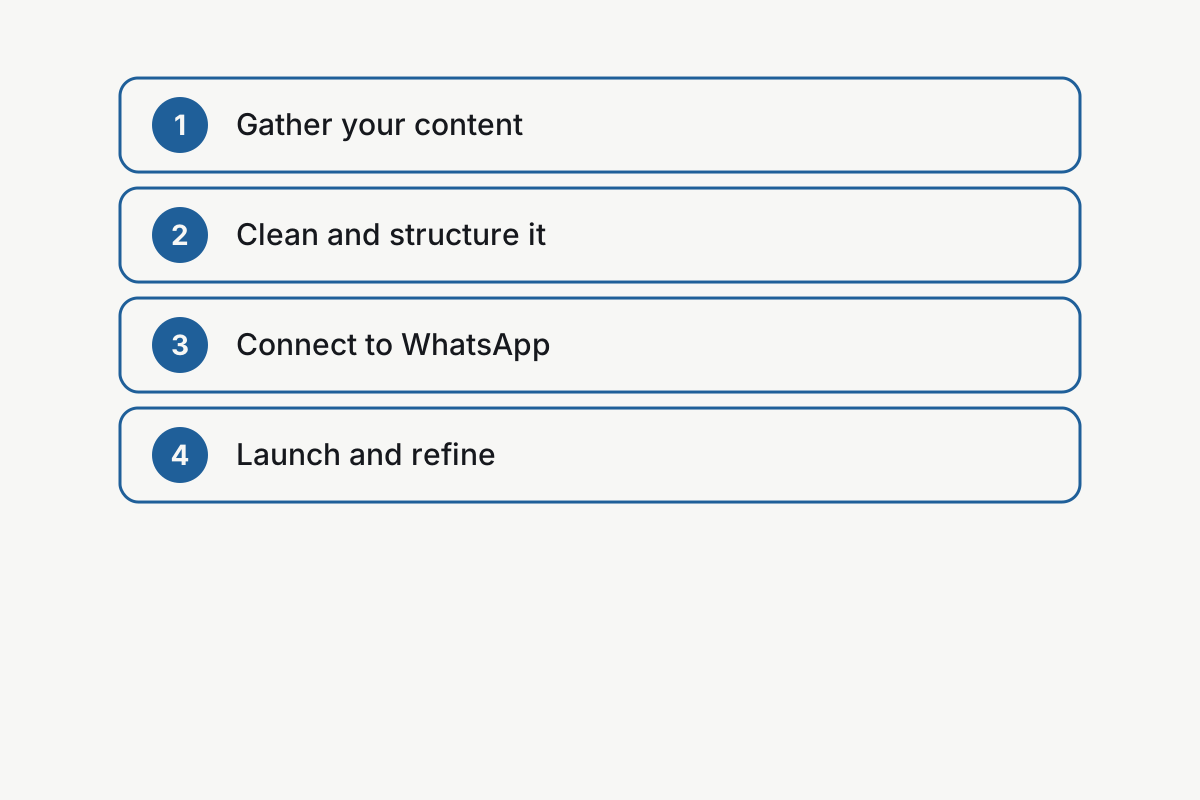
You do not need a six-month project. A focused team can go from blank page to live WhatsApp automation in a matter of weeks. Here is the sequence.
Step 1: Gather your content
Pull together every document that contains customer-facing information. Help-centre articles, email templates, training guides, policy documents, WhatsApp conversation logs from your agents. Interview your support team: what do customers ask most? What do they ask in ways that are hard to anticipate? Capture the real phrasing, not the polished version.
Step 2: Clean and structure it
Break every document into individual question-and-answer blocks. Write each answer in plain, conversational language. If your customers write in Arabic and English, create entries in both languages. Remove jargon. Remove internal references. Each block should make sense on its own, without the surrounding document for context.
Step 3: Connect it to WhatsApp
This is where the AI layer plugs into your WhatsApp Business API. The system is configured to read incoming messages, search the knowledge base, compose a reply, and send it. You set the rules: which topics the AI handles autonomously, which always go to a human, and what tone and language it uses. For businesses in Qatar, this step also covers Arabic-language handling, which requires a model and configuration that genuinely understands dialect and formal register, not just Modern Standard Arabic.
Step 4: Launch, monitor, and refine
Go live on a subset of enquiries first. Watch the conversations. Where did the AI answer well? Where did it hesitate or hand off? Where did a customer rephrase because the first answer missed the mark? Each of those moments is a content gap to fill or a phrasing to improve. In the first month, expect to refine entries weekly. After that, a monthly review keeps the knowledge base sharp.
Where an AI knowledge base fits in a wider automation strategy
Customer support is one of the highest-impact starting points for AI automation, but it is rarely the only one. The same knowledge-base infrastructure that answers WhatsApp support questions can feed AI sales automation, responding to pre-sale enquiries about pricing, availability, and service scope without waiting for a sales rep to come online.
For businesses handling invoices, payment queries, and billing disputes on WhatsApp, the knowledge base extends naturally into finance automation, giving customers instant answers to "When is my payment due?" or "How do I request a refund?" without routing every question to an accounts team.
And for operations-heavy businesses in Qatar, logistics, facilities, contracting, the same pattern applies to internal queries from staff and partners. Operations automation built on a shared knowledge base means the answer to "What is the safety protocol for site X?" is one WhatsApp message away, not buried in a shared drive.
How BAYNOR AI builds AI knowledge base automation for WhatsApp
At BAYNOR AI, we design and deploy AI knowledge base systems for businesses across Qatar, built specifically for the WhatsApp channel and the bilingual reality of the local market. Our work covers the full arc: auditing your existing content, structuring it into AI-ready entries in Arabic and English, configuring the WhatsApp Business API integration, setting escalation rules, and staying with you through the refinement period after launch.
We do not hand you a generic chatbot and wish you luck. We build the knowledge base around your actual customer conversations, test it against real question patterns, and make sure the handoff to your human team is seamless. If you are exploring WhatsApp Business automation in Qatar, we start with a conversation about where your support load is heaviest and where automation would relieve it fastest.
You can also reach us in Arabic through our Arabic-language page, or learn more about our team and approach on our about page.
FAQ
What is an AI knowledge base in customer support?
An AI knowledge base is a structured collection of verified answers, product information, policies, and procedures that an AI system searches automatically to reply to customer questions. In customer support, it replaces the manual process of an agent looking up an answer, allowing the AI to respond in seconds on channels like WhatsApp.
Can an AI knowledge base handle Arabic customer messages on WhatsApp?
Yes, provided the system is configured with Arabic-language entries and a model trained to understand both Modern Standard Arabic and regional dialect. For businesses in Qatar, this is essential. A well-built knowledge base includes parallel entries in Arabic and English, and the AI detects the customer's language and replies accordingly.
How long does it take to set up an AI knowledge base for WhatsApp support?
A focused project typically moves from content audit to live deployment in a few weeks, depending on how much existing content needs to be restructured. The content gathering and cleaning phase is usually the longest part. The technical integration with the WhatsApp Business API and the AI layer can be completed in a shorter window once the content is ready.
What happens when the AI cannot answer a question?
The conversation is handed to a human agent. A well-designed system transfers the full conversation context, what the customer asked, what the AI already responded, and where it got stuck, so the agent can pick up without making the customer repeat themselves. The handoff threshold is configurable: you decide which topics always go to a person.
Do I need to replace my support team with an AI knowledge base?
No. The AI handles the repetitive, high-volume questions that consume most of an agent's day. Your team shifts to complex enquiries, escalations, and relationship management. The result is a smaller repetitive workload per agent, not fewer agents. Most businesses find their team can handle higher total message volume without growing headcount.
Is WhatsApp Business API required, or does it work on a regular WhatsApp number?
An AI knowledge base integration requires the WhatsApp Business API, not the standard WhatsApp or WhatsApp Business app. The API allows programmatic access to incoming and outgoing messages, which is how the AI reads questions and sends replies. The setup involves registering a business number through an approved provider, which is part of the deployment process.
How do you keep the knowledge base accurate over time?
Schedule a regular review cycle, monthly for most businesses. During each review, check for outdated answers, add entries for new questions the AI handed off, and refine phrasing based on real conversation logs. The AI's handoff data is the best signal for where the knowledge base has gaps, because every handoff represents a question it could not answer.